
Looking for exactly how to fix enamel on teeth before your sensitivity turns into severe pain? When your teeth start looking translucent or feel a sharp sting from a simple glass of ice water, your enamel is actively failing. The harsh reality is that this protective armor never grows back. Ignoring it guarantees rapid decay and brittle teeth. However, advanced dentistry can permanently rebuild this shield. Here are the most effective clinical solutions available today.
What Is Tooth Enamel?
Teeth enamel is the highly mineralized, translucent outer layer that covers the visible part of your tooth (the crown). Composed primarily of a tough mineral called hydroxyapatite, it serves as the first line of defense against the physical and chemical stress your teeth endure every day. Because enamel contains no living cells, it lacks the biological ability to repair itself once cracked, chipped, or eroded.
Read More About: What Does Crack Do to Your Teeth?
What Does Tooth Enamel Do?
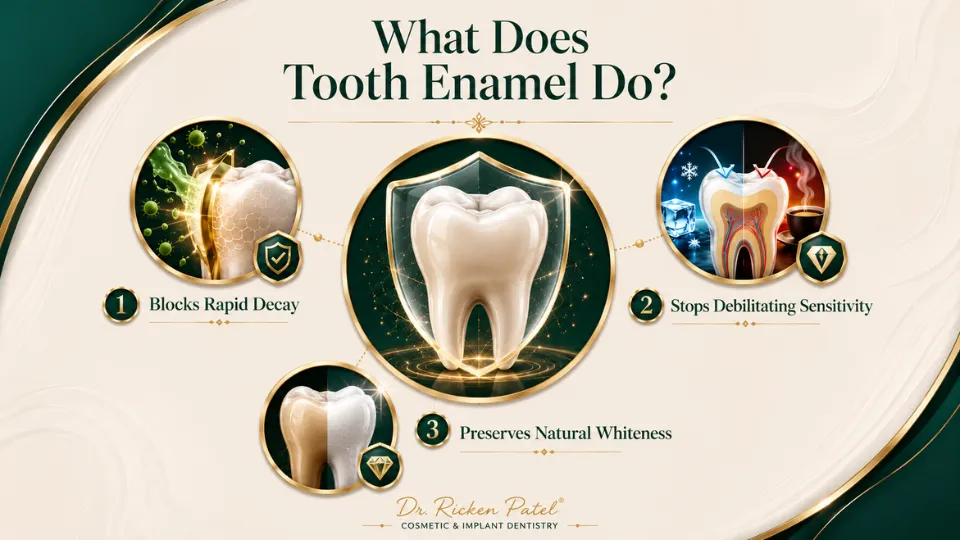
Tooth enamel is not just a cosmetic shell; it is the tooth’s primary structural defense against daily chemical and physical assault. When intact, it performs three critical functions:
1- Blocks Rapid Decay
It acts as an impenetrable barrier, preventing corrosive dietary acids and plaque bacteria from aggressively eating into the dentin, the softer inner core where decay spreads rapidly and destroys the tooth from the inside out.
2- Stops Debilitating Sensitivity
Enamel completely seals off the microscopic tubules that lead directly to the tooth’s central nerve. Without this dense insulation, routine actions like drinking iced water or even breathing cold air trigger sharp, shooting pain.
3- Preserves Natural Whiteness
Because healthy enamel is highly dense, it naturally reflects light, effectively masking the dark, yellow dentin underneath. The moment this layer thins, teeth lose their bright appearance and immediately look aged, stained, and structurally compromised.
What Causes Teeth Enamel Damage?
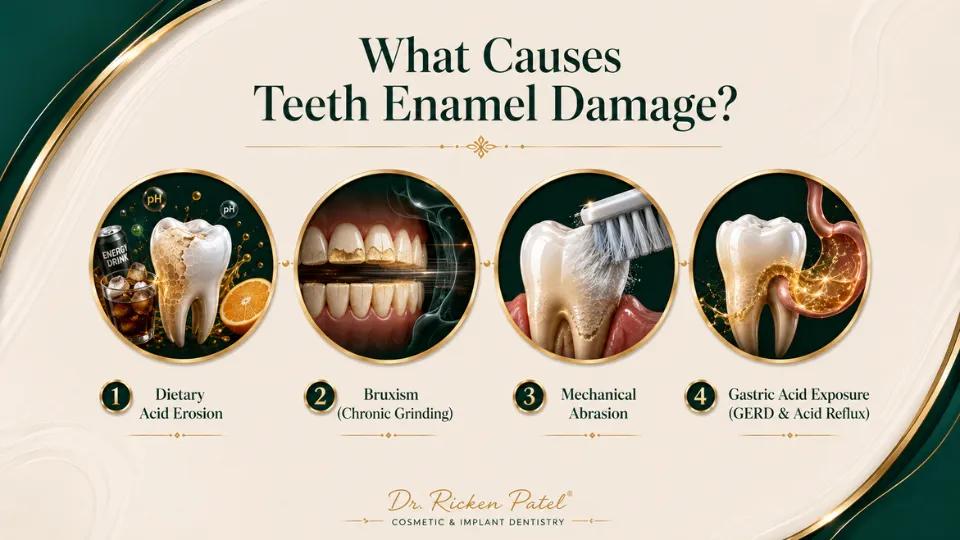
Enamel destruction is rarely an overnight event; it is the result of chronic chemical, mechanical, or biological assault. This progressive structural breakdown is primarily driven by:
1- Dietary Acid Erosion
Frequent exposure to highly acidic beverages such as sodas, energy drinks, and citrus juices triggers rapid demineralization. This constant chemical assault actively dissolves the hydroxyapatite crystals that give enamel its rock-hard structure, leaving the teeth porous and weak.
2- Bruxism (Chronic Grinding)
Severe nighttime grinding and clenching place immense, unnatural force on the bite. This extreme mechanical friction literally obliterates the protective layer, causing micro-fractures and aggressively wearing the enamel down to a flat, highly vulnerable dentin surface.
3- Mechanical Abrasion
Aggressive brushing techniques and hard-bristled toothbrushes do more harm than good. Scrubbing teeth with excessive force physically scours away the enamel, especially near the gumline, permanently stripping the tooth’s armor and exposing the sensitive root structure.
4- Gastric Acid Exposure (GERD & Acid Reflux)
Stomach acid is highly corrosive due to its exceptionally low pH. When chronic reflux forces this acid into the oral cavity, it silently and aggressively melts away the enamel on the lingual (back) surfaces of the teeth, often causing severe damage before the patient even realizes it.
Signs And Symptoms Of Enamel Erosion
Identifying enamel erosion early is critical to preventing complex dental failures. Look for these clear indicators:
- Severe Sensitivity: A sharp, immediate pain when consuming hot, cold, or highly sweet foods.
- Discoloration and Yellowing: As the white enamel thins, the underlying yellow dentin becomes highly visible.
- Translucent Edges: The biting edges of your teeth may appear clear, thin, or glass-like.
- Cupping: Small indentations or pits form on the chewing surfaces of the teeth.
- Cracks and Chips: Thinned enamel becomes brittle, leading to micro-fractures and jagged edges.
How To Fix Enamel On Teeth?
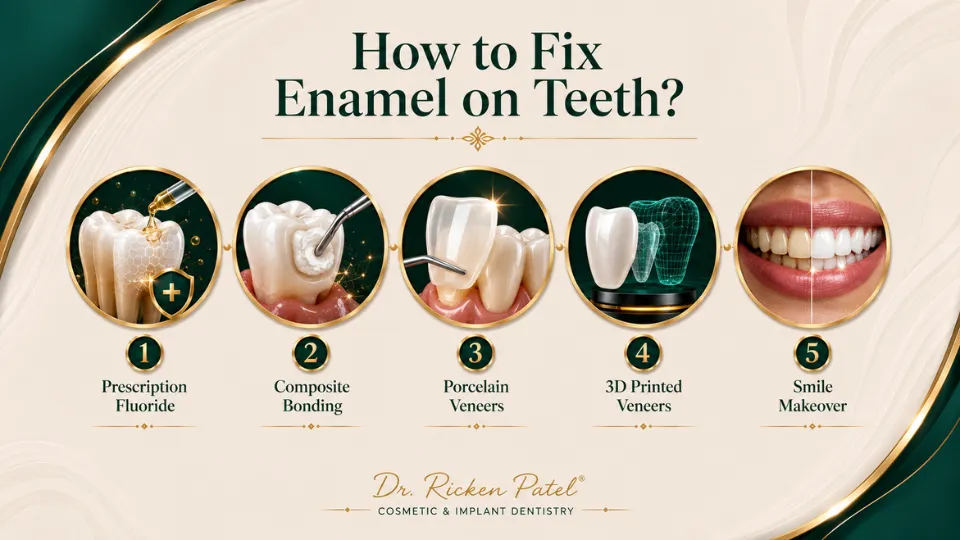
Lost enamel cannot biologically regenerate. The only clinical answer for how to fix enamel on teeth is an expert cosmetic dentist who permanently rebuilds the tooth, delivering essential structural repair and flawless aesthetics.
1- Prescription Fluoride
For early-stage demineralization, prescription-strength fluoride is the first line of defense. While it cannot physically replace missing volume, it aggressively remineralizes and hardens the remaining enamel structure. This stabilizes the tooth and halts minor erosion before invasive structural repair becomes mandatory.
2- Composite Bonding
For mild to moderate enamel loss, advanced composite bonding provides an immediate physical shield. A high-strength cosmetic resin is directly bonded over the compromised areas, instantly sealing exposed microscopic tubules. This completely stops thermal sensitivity and efficiently replaces the missing protective layer in a single visit.
3- Porcelain Veneers
Custom porcelain veneers act as a permanent, ultra-durable shield for moderate to severe enamel loss. These ultra-thin shells instantly replace lost volume and hide deep yellowing. Applied via a minimal-prep technique, they permanently restore the tooth’s surface while preserving its underlying natural structure.
Read More About: Most Natural Looking Veneers
4- 3D Printed Veneers
Digitally fabricated to match your exact micro-anatomy, 3D printed veneers offer a high-precision, minimal-prep solution for damaged enamel. They efficiently rebuild the tooth’s protective layer while ensuring structural strength and a seamless, natural appearance.
5- Smile Makeover
When widespread erosion compromises your bite, a Smile Makeover provides complete structural restoration. Utilizing Smile Simulation, Dr. Patel previews your results before strategically combining advanced composite bonding.
Ultimately, professional cosmetic dental services provide the only permanent solution for replacing lost enamel.
Which Enamel Erosion Treatment Is Right For You?
Treatment depends on damage severity. Minor demineralization may stabilize with prescription fluoride, but visible enamel loss, deep yellowing, and chronic sensitivity require immediate structural intervention.
As a Rutgers-trained dentist, Dr. Ricken Patel accurately diagnoses the exact extent of the hidden damage. Through detailed digital planning and smile simulation, we will guide you toward the exact restorative solution, whether bonding, veneers, or crowns, that will permanently secure your oral health and aesthetic goals.
Ready to permanently replace your lost enamel?
Restore your tooth’s structure and durability with advanced, lasting treatments designed for your smile.
Trusted by 15,000+ Satisfied Patients
Conclusion
Finally, once your enamel is gone, it is gone for good. If you are still trying to figure out how to fix enamel on teeth, you need to ignore the claims about miracle toothpastes. You cannot grow it back; you can only replace it. The only real solution is to have a professional replace the lost teeth with restorations such as veneers or bonding. That is genuinely the only way to reduce sensitivity and protect your teeth from decay.
FAQ About How To Fix Enamel On Teeth
1. Can I naturally regrow my tooth enamel?
No. Enamel is completely acellular, meaning it cannot biologically regenerate once it is gone.
2. How do you fix severe enamel loss?
Severe enamel loss is permanently fixed using advanced cosmetic and restorative dentistry. Dr. Ricken Patel expertly replaces the lost structure utilizing custom porcelain crowns, porcelain veneers, or advanced composite bonding, depending on the tooth’s condition.
3. Is restoring enamel painful?
No. Dr. Patel is dedicated to a comfort-focused, anxiety-free patient experience.
4. Can any toothpaste actually restore my lost enamel?
No. Because enamel contains no living cells, it cannot grow back.
5. How do I know if my enamel is severely damaged?
The most obvious signs are chronic sensitivity to hot or cold, the edges of your teeth appearing transparent, and a deep, stubborn yellow color. That yellowing is not a surface stain; it is the inner core of the tooth (dentin) showing through because your protective white armor is gone.
6. What happens if I ignore enamel erosion?
Ignoring the damage leaves the vulnerable, soft dentin completely exposed to bacteria and daily acids. This will not stabilize on its own; it inevitably leads to rapid decay, constant pain, and ultimately forces a complete tooth extraction.