
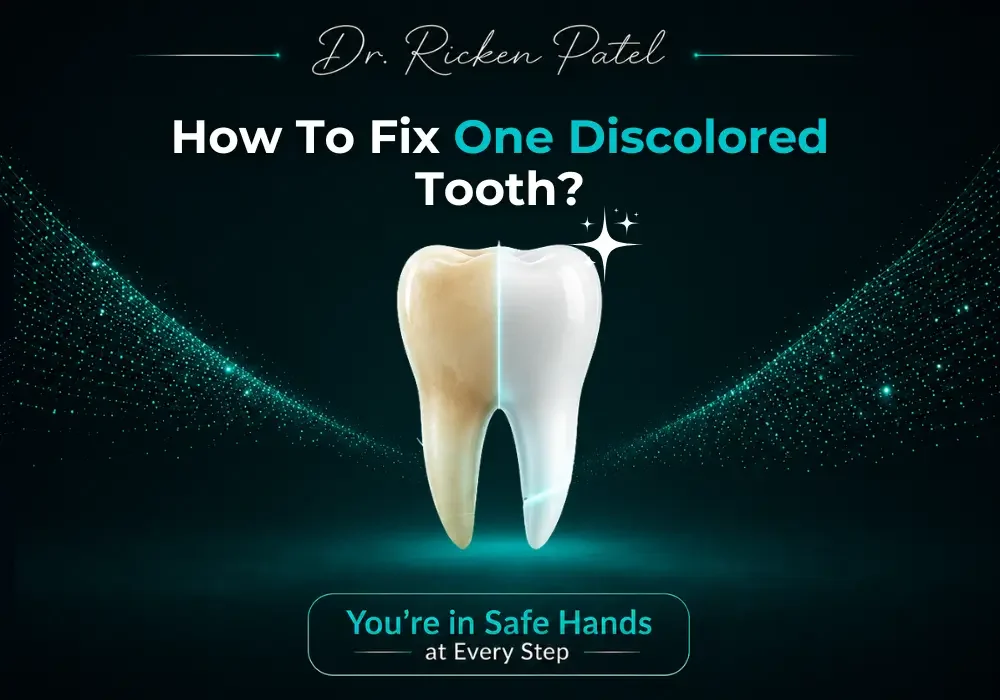
You catch it in every photo: that one dark tooth. Whitening strips fail because the problem is usually inside, often an early warning sign of internal damage or a dying root. This isn’t just cosmetic noise. With 74% of Americans believing an unattractive smile hurts career success and 99.7% considering a healthy smile a crucial social asset, that single tooth costs your daily confidence. Ignoring it makes it a dental emergency on a slow timer. If this is bothering you, our guide on how to Fix One Discolored Tooth is exactly where you need to start.
What Is A Discolored Tooth?
A discolored tooth is any single tooth that appears darker, grayer, yellower, or differently pigmented compared to the teeth around it. Unlike generalized staining, which affects most teeth from coffee, tea, or tobacco, a single discolored tooth stands alone, and that contrast is precisely what makes it so visible.
The discoloration can live on the surface (extrinsic) or deep inside the tooth structure itself (intrinsic). That distinction matters enormously because it determines whether whitening will do anything at all or whether you need a clinical solution that actually addresses the root cause. Most people waste months and money on whitening products that can’t touch intrinsic staining. The first step is knowing which type you’re dealing with.
Why Is Only One Tooth Discolored?
General staining from food or drink affects multiple teeth. When only one tooth changes color, it is a clinical warning sign of a specific, localized issue such as past physical trauma, hidden decay, a deteriorating old filling, or a dying nerve. Because this isolated discoloration is a structural issue rather than a surface stain, it requires targeted treatment instead of standard whitening.
Causes Of A Discolored Tooth
1- Internal Causes (Inside The Tooth)
- Pulp necrosis (dead tooth nerve): When past trauma kills the internal nerve and blood supply, the tissue breaks down, and the tooth darkens from within. According to a 2024 systematic review published in Dental Traumatology, pulp necrosis occurred in approximately 57% of teeth affected by lateral luxation injuries.
- Internal bleeding from trauma: A direct blow causes bleeding inside the tooth. Hemoglobin from the blood breaks down over months, permanently staining the dentin gray or brown.
- Old root canal treatment: Older endodontic materials and medicaments can oxidize over time, staining the tooth from the inside out and causing a noticeable gray discoloration that worsens with age.
- Tetracycline antibiotic exposure: Antibiotics taken during tooth development can incorporate into the tooth structure and cause deep, banded staining, typically affecting multiple teeth but sometimes isolated to a single tooth.
2- External Causes (On The Surface)
- Decay reaching the dentin: When a cavity penetrates beyond the enamel and into the softer dentin, it can turn the tooth yellow, brown, or black. This is both a health and cosmetic issue that requires immediate treatment.
- Corroding metal (amalgam) fillings: Old silver fillings release metallic compounds that seep into the surrounding tooth structure over decades, turning the entire tooth dark gray.
- Localized plaque and surface staining: One tooth with micro-fractures, exposed dentin, or a rough surface accumulates stains far faster than surrounding teeth.
Different Types Of Tooth Discoloration
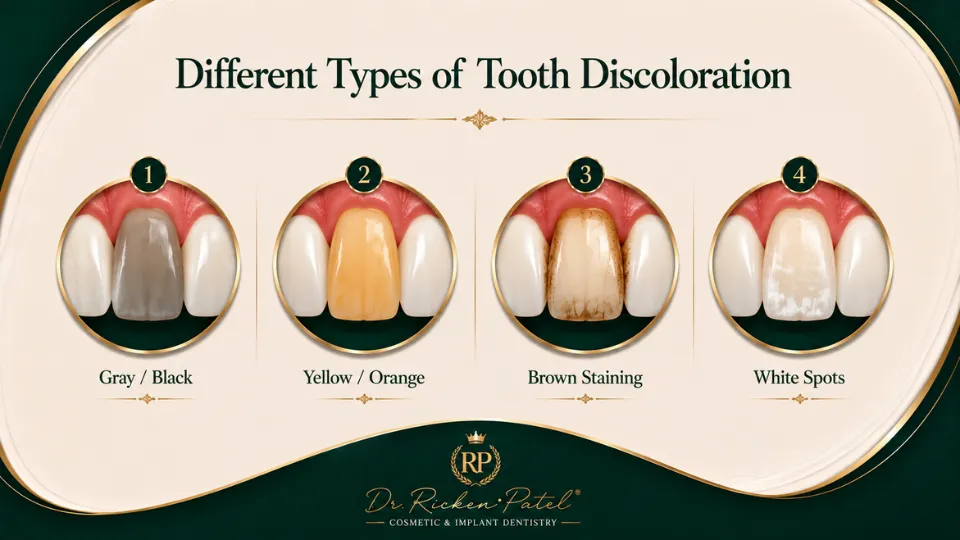
1- Gray or Near-Black Discoloration
This almost always indicates internal damage, a dead nerve, trauma-related internal bleeding, or old root canal work.
2- Yellow or Orange Discoloration
Typically signals active decay or a deteriorating restoration underneath. The tooth may feel slightly sensitive or have visible brown edges at the gum line.
3- Brown or Dark Staining (Localized)
This appears at the gum line or on specific surfaces and often results from surface deposits, old amalgam leaching, or early decay. It can sometimes be addressed with professional cleaning and bonding.
4- White Chalky Spots or Mottled Appearance
This pattern typically indicates fluorosis or early demineralization. These spots are permanent; they won’t disappear with whitening, but they respond well to advanced composite bonding techniques.
Read Also: What Causes White Patches on Teeth?
How To Fix One Discolored Tooth?
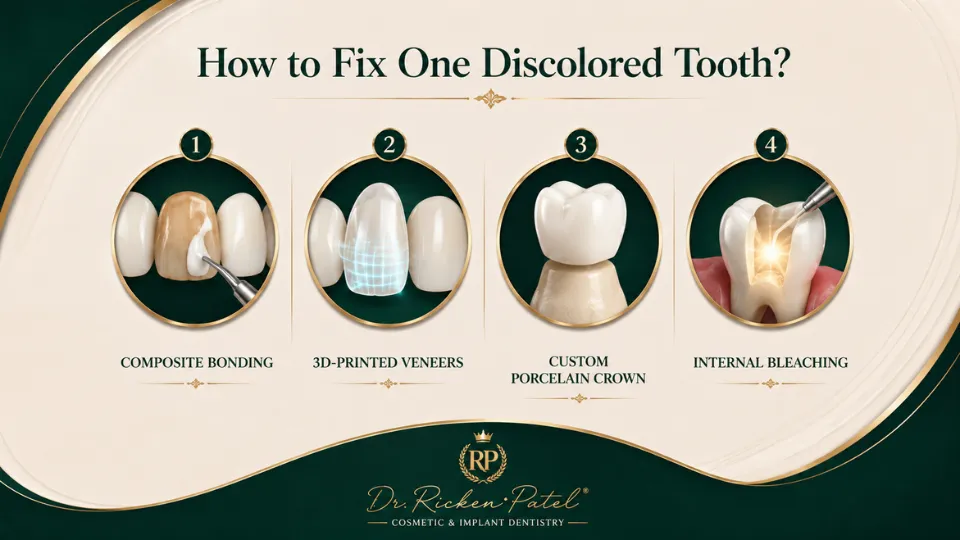
When dealing with a single dark tooth, the right treatment depends entirely on the root cause. If you are wondering how to fix one discolored tooth, modern cosmetic dental services offer several highly effective, minimally invasive solutions to restore your smile seamlessly.
Here is a breakdown of the most reliable clinical options:
1- Composite Bonding
Ideal for structurally intact teeth, composite bonding is a conservative, single-visit procedure. A shade-matched resin is sculpted directly over the discoloration and light-cured, requiring minimal prep and preserving your natural enamel. This seamless, natural-looking solution lasts 7–10 years with proper care.
Read Also: How to Fix Enamel on Teeth?
2- 3D-Printed Veneers
Custom 3D-printed veneers are ideal for highly visible front teeth that require precise shade matching. These ultra-thin shells perfectly mimic the exact color, translucency, and light reflection of your natural teeth. Using minimal-prep techniques, little to no tooth structure is removed, often requiring zero preparation, preserving your natural tooth while delivering a flawless aesthetic.
3- Custom Porcelain Crown
For a discolored tooth with decay, fractures, or a prior root canal, a custom porcelain crown is the ideal long-term solution. Covering the entire tooth, the restoration provides essential structural protection and completely masks the discoloration. This natural-looking restoration blends seamlessly with your smile and can last 15 years or more.
Read Also: Most Natural Looking Veneers
4- Internal Bleaching
For a discolored tooth that has had a root canal but remains structurally sound, internal bleaching is a highly effective, conservative option. By sealing a whitening agent inside the tooth chamber, we can lighten it from within over several appointments, avoiding the need for a crown or veneer.
Choosing The Right Solution For You?
Finding the perfect fix starts with an expert cosmetic dentist who balances your aesthetic goals with the long-term health of your tooth.
So, the ideal treatment depends on three factors:
- the type of discoloration,
- the tooth’s structural integrity
- your aesthetic goals.
Dr. Patel prioritizes the most conservative, effective solution to preserve your natural tooth structure. Every patient begins with a Smile Simulation, an advanced process that visualizes your new smile based on your unique facial proportions and skin tone. You preview and approve the results before any treatment begins, ensuring a transparent, anxiety-free, and personalized experience.
Ready to Fix Your Discolored Tooth?
The most effective solution for your tooth discoloration is to achieve a brighter, more natural-looking smile.
Trusted by 15,000+ Satisfied Patients
Conclusion
Ultimately, knowing how to Fix One Discolored Tooth comes down to treating the structural root cause rather than wasting time on surface-level whitening. Because an isolated dark tooth almost always points to internal damage like past trauma or a dead nerve, it requires a specific clinical approach. By choosing the right restorative solution, whether that is composite bonding, internal bleaching, or a custom crown, you can permanently repair the underlying issue and seamlessly restore your natural smile.
FAQ About How To Fix One Discolored Tooth
1. Can teeth whitening fix a gray or brown tooth?
No. Professional whitening, even in-office treatments, works exclusively on external surface stains.
2. How do I fix a discoloured tooth without a crown?
For structurally sound teeth, advanced composite bonding or 3D-printed veneers are highly effective, minimal-prep alternatives to crowns.
3. Does a discolored tooth mean the nerve is dead?
Not always, but it is a serious possibility that requires professional evaluation.
4. How long does it take to fix a single discolored tooth?
Composite bonding typically requires one appointment lasting 60 to 90 minutes. 3D-printed veneers or crowns usually take two appointments over one to two weeks. Internal bleaching generally requires two to three appointments spaced one to two weeks apart.