
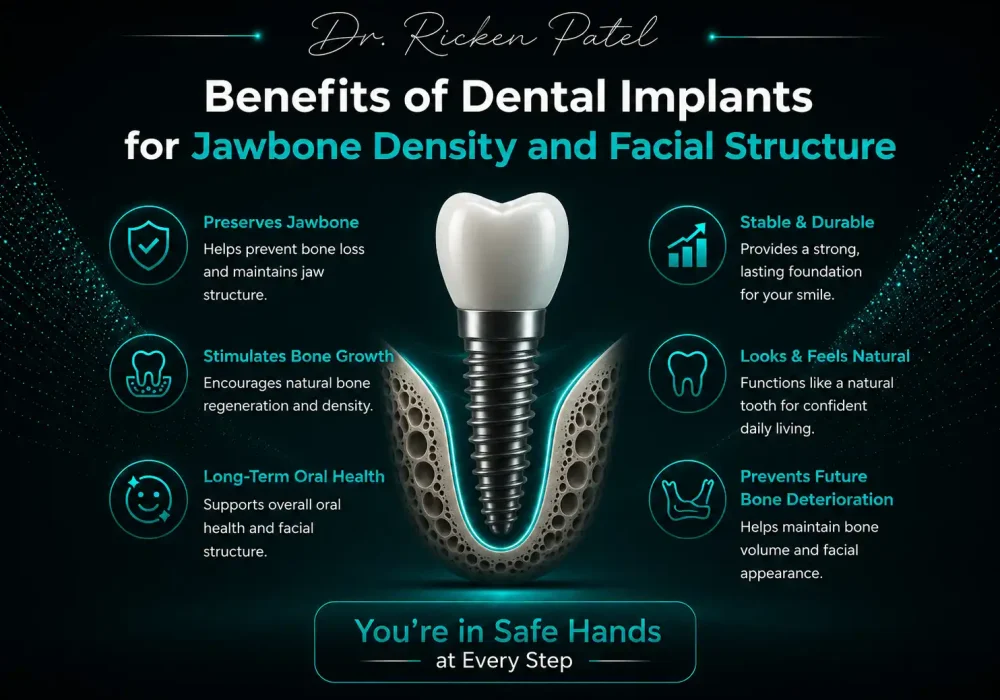
Losing a tooth is about more than just a gap in your smile. Over time, it quietly reshapes your jawbone and your face. When you lose a tooth, the underlying bone can begin to deteriorate due to lack of stimulation, and this degradation not only affects your oral health but also alters your appearance over time.
Dental implants are the only tooth replacement option that addresses this problem at the root. Here’s a complete guide to the benefits of dental implants for jawbone density.
What Is Jawbone Density and Why Is It Important?
Jawbone density refers to the mineral concentration, primarily calcium and phosphate, in the bone that anchors your teeth. The jawbone provides support for the teeth, gives structure to the face, and helps maintain proper alignment.
When the jawbone is healthy, it fosters strong connections with surrounding tissues, supports the life-changing impact of dental implants, and allows individuals to eat comfortably and speak clearly without difficulty. A robust jawbone not only supports oral health but also helps maintain well-defined facial contours.
How Is Jawbone Density Diagnosed?
Before placing dental implants, your dentist will carefully assess the quality and quantity of your jawbone to ensure successful implant placement.
- Uses advanced imaging techniques, such as Cone Beam Computed Tomography (CBCT) scans, to obtain detailed 3D images of the jaw and surrounding structures.
- Measures the bone height to determine the distance between the jaw ridge and important anatomical structures, such as the sinus cavity or nerve canal.
- Evaluates the bone width across the ridge to ensure there is adequate space for the implant.
- Confirms that there is sufficient healthy bone to fully support and surround the dental implant.
- Recommends bone grafting if the jawbone is too narrow or lacks the necessary height for implant placement.
Bone Density Classification (Understanding D1, D2, D3, and D4)
Not all jawbone is the same. Dentists classify jawbone density into four main types:
| Bone Type | Description | Implant Suitability |
|---|---|---|
| D1 | Very dense bone, usually in the front of the lower jaw. | Excellent ✓ |
| D2 | Dense bone with some flexibility. | Very Good ✓ |
| D3 | Softer bone with less density. | Extra Healing Needed |
| D4 | Very soft bone, often in the upper back jaw. | Bone Graft May Be Needed |
If you have D1 or D2 bone, your implant often achieves strong initial stability. If you have D3 or D4 bone, your cosmetic dentist may adjust the implant size, drilling method, or healing time to improve results, knowing all the benefits of dental implants for jawbone density.
How Tooth Loss Affects Jawbone Density
Missing teeth can lead to gradual jawbone loss over time. This happens because the bone relies on stimulation from tooth roots for strength and density. Without that stimulation, the body starts to resorb the bone tissue.
Over time, this can lead to noticeable changes in facial structure; the cheeks may appear sunken as volume decreases.
Additionally, neighboring teeth may shift into the gap, affecting your bite and causing jaw discomfort. Tooth loss can also weaken the jawline, contributing to a prematurely aged appearance.
How Implants Improve Chewing and Jawbone Health
How dental implants prevent jawbone loss? Dental implants help preserve jawbone density by replacing the function of natural tooth roots and stimulating the bone during everyday activities like chewing and biting.
- Natural tooth roots provide continuous stimulation to the jawbone, helping maintain its strength and density.
- When a tooth is lost, the lack of stimulation causes the surrounding bone to shrink over time through a process known as bone resorption.
- Dental implants are designed to mimic natural tooth roots by integrating with the jawbone.
- The pressure generated during chewing and biting stimulates the bone, encouraging it to maintain healthy bone levels.
- Implants provide a stable foundation for artificial teeth while supporting long-term bone health.
- Unlike other tooth replacement options, dental implants actively help preserve the jawbone rather than simply filling the gap left by a missing tooth.
Benefits of Dental Implants for Jawbone Density and Facial Structure
By opting for dental implants, individuals can safeguard their jawbone from further loss while restoring function and aesthetics. The key benefits of dental implants for jawbone density include:
1. Preserved bone density
Dental implants are capable of preventing the jaw from bone loss through the function of artificial tooth roots that stimulate the bone during chewing.
2. Maintained facial structure
A healthy jawbone helps maintain facial contours, preventing the sunken look often associated with missing teeth. Well-preserved bone density can prevent sagging cheeks and a sunken appearance, contributing greatly to youthful looks.
3. Improved chewing function
Dental implants not only restore the lost ability to chew or speak naturally, but also maintain the beauty of the face through sustaining the bone structure.
4. Stopped tooth shifting
Implants further stop the teeth that are next to the open space from moving, which is what happens when a tooth is missing.
5. Long-term durability
Unlike dentures or bridges, implants fuse with the bone permanently giving you a solution that looks, feels, and functions like your natural teeth.
The Dental Implant Procedure and Recovery Process
The process starts with the examination of the health of the jawbone through imaging techniques. If bone loss is too significant, a bone graft or sinus lift may be necessary to prepare the site.
A healing period then follows during which osseointegration takes place; the implant fuses with the bone, and only then can the abutment and crown be attached.
Overall health, oral hygiene, smoking, and bone density are some of the factors that affect success levels. Benefits of dental implants for jawbone density, good oral care and regular dental visits are necessary for the maintenance of implants and the health of the jawbone long-term.
Why Choose Dr. Ricken Patel for Dental Implants?
Choosing an experienced implant dentist is essential for achieving long-lasting, natural-looking results with dental implants.
- Dr. Ricken Patel is a Rutgers-trained cosmetic dentist with advanced certifications in dental implant procedures and expertise in digital smile design.
- He combines modern dental technology with a conservative, patient-focused approach to create personalized treatment plans based on each patient’s anatomy and goals.
- Whether you are considering All-on-4 dental implants or All-on-6 dental implants, Dr. Patel and his team provide comprehensive guidance throughout the entire treatment process.
- Patients receive thorough evaluations, including bone density assessments, before proceeding with implant placement and final crown restoration.
- The practice is committed to delivering clear communication, precision-driven care, and a comfortable patient experience.
- Dental implant services are available at three convenient New Jersey locations: Brunswick Smiles, Mercer Smiles, and Promenade Smiles.
Conclusion
Missing teeth do more damage than most people realize, and the longer you wait, the more bone you lose. So, after knowing about the benefits of dental implants for jawbone density, you must be ready to stop bone loss in its tracks and restore your smile from the foundation up. Explore the best cosmetic dental services and take the first step today.
FAQs About Dental Implants and Jawbone Density
1. Do Dental Implants Prevent Jawbone Loss?
Yes. prevent jawbone loss with implants surgically into the jawbone and merge with the bone through a process known as osseointegration. This keeps the jawbone intact, as it is the same bone that would otherwise be resorbed when a tooth is missing.
2. How Long Does It Take For an Implant To Integrate With The Jawbone?
Osseointegration typically takes 3 to 6 months, depending on your bone density and overall health. D3 and D4 bone types may require longer healing periods.
3. Can I Get Implants If I Already Have Some Bone Loss?
In many cases, yes. If your ridge is too narrow or too short, your dentist may suggest bone grafting first to rebuild the foundation before implant placement.
4. Are Dental Implants Better Than Dentures For Jawbone Health?
Unlike traditional dentures or bridges, which are non-invasive and don’t stimulate the bone, implants actively preserve bone density by replicating the pressure exerted by natural tooth roots during chewing.
5. What Bone Density Do I Need For Dental Implants?
D1 and D2 are ideal for implants, while D3 may require additional support. D4 bone may need augmentation procedures before implants can be placed safely.