
A sudden, sharp sting when chewing can instantly ruin your meal and leave you wondering what makes teeth crack. While it’s tempting to blame an unexpected almond or a piece of ice, the truth is that healthy enamel rarely shatters on impact. That sudden fracture is actually the final result of hidden daily habits silently weakening your teeth over time. Let’s uncover the real culprits putting your smile at risk.
Teeth Crack Definition
In the medical field, a cracked tooth occurs when a physical fracture develops in the hard outer shell of the tooth, known as the enamel. Depending on the severity, this structural failure can remain superficial or extend deeper into the dentin (the softer layer beneath the enamel), eventually reaching the pulp where the nerves and blood vessels reside.
What Makes Teeth Crack?
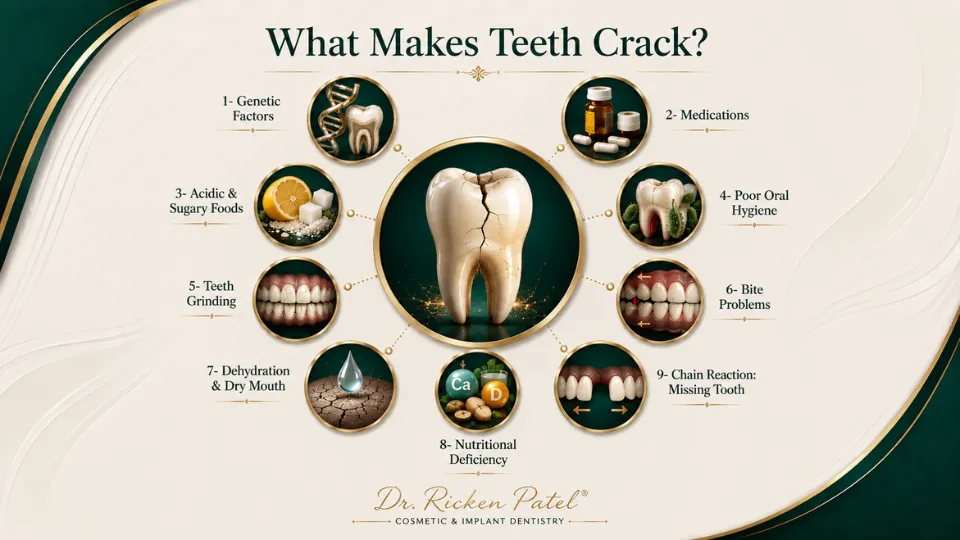
Understanding what makes teeth crack requires looking beyond sudden accidents. While biting down on an olive pit or a piece of hard candy is a common trigger, the underlying truth is that teeth usually fracture because their structural foundation has been slowly weakened over time. The main causes of cracked teeth are often cumulative.
1- Genetic Factors
Genetics dictate your baseline tooth strength and enamel thickness. Inherited conditions or natural traits can leave teeth abnormally thin and brittle, making them highly susceptible to fracturing under daily wear.
2- Medications
Many patients are unaware that their daily prescriptions can compromise their smile. Certain medications, particularly selective serotonin reuptake inhibitors (SSRIs) used for anxiety and depression, have been clinically linked to increased nighttime jaw clenching. Additionally, hundreds of common medications cause severe dry mouth, removing the saliva necessary to remineralize and protect enamel, leaving teeth dry, brittle, and prone to splitting.
3- Acidic and Sugary Food
Sugary and acidic diets erode enamel by stripping away essential minerals. This chemical thinning makes your teeth highly susceptible to cracking under normal biting pressure.
4- Poor Oral Hygiene
Poor oral hygiene breeds bacteria that decay and hollow out the tooth from the inside. This destroys its internal support, causing the remaining fragile shell to collapse easily under normal biting pressure.
5- Teeth Grinding
Also known as bruxism, chronic teeth grinding is arguably the leading cause of structural tooth failure. According to the University of Rochester Medical Center, the human jaw can exert up to 250 pounds of force per square inch during sleep, a grinding, which actually exceeds your maximum bite force while awake. This immense, unnatural pressure creates microscopic stress fractures in the enamel that eventually deepen into severe, painful cracks.
6- Bite Problems
A healthy bite distributes chewing forces evenly across all your teeth. However, if you suffer from malocclusion (misaligned teeth), certain teeth are forced to bear a disproportionate amount of the biting load. This uneven distribution of force overworks specific teeth, leading to accelerated wear and inevitable stress fractures.
Read More About: What Is a Malocclusion?
7- Dehydration And Dry Mouth
Saliva is your mouth’s natural defense mechanism. It neutralizes dietary acids and constantly washes calcium and phosphate back into the enamel. Chronic dehydration or medically induced dry mouth halts this remineralization process. Without the protective buffering of saliva, teeth become severely weakened and brittle.
8- Nutritional Deficiency
Just like your bones, your teeth require a steady supply of specific nutrients to maintain their density. A prolonged deficiency in essential minerals and vitamins, particularly Calcium, Vitamin D, and phosphorus, prevents the body from maintaining strong enamel and healthy alveolar bone support, increasing the risk of structural dental failure.
9- Chain Reaction
Leaving a missing tooth unreplaced forces the remaining teeth to shift and absorb extra chewing pressure. This mechanical overload inevitably causes healthy teeth to crack and fail.
Types Of Cracked Teeth?
Not all dental fractures are created equal. The American Association of Endodontists classifies cracked teeth into five distinct categories, each requiring a different level of intervention:
- Craze Lines: Shallow, microscopic scratches localized entirely in the outer enamel.
- Fractured Cusp: A piece of the tooth’s chewing surface breaks off, usually around an old, large filling.
- Cracked Tooth: A vertical fracture extending from the chewing surface down toward the gum line.
- Split Tooth: The result of an untreated cracked tooth. The fracture completely separates the tooth into two distinct segments.
- Vertical Root Fracture: A crack that originates at the root beneath the gum line and travels upward.
Signs And Symptoms Of Cracked Teeth
Identifying a fracture early can mean the difference between a simple restoration and a total tooth extraction.
Watch for these distinct warning signs:
- Erratic Pain: Unlike the constant throbbing of a cavity, a cracked tooth usually hurts only when you are actively chewing.
- Release Pain: A sharp, stabbing pain specifically when you release your bite, rather than when you bite down.
- Temperature Sensitivity: A sudden, lingering flash of pain when consuming hot coffee, ice water, or excessively sweet foods.
- Gum Swelling: Localized swelling or a small pimple-like bump on the gum line near the suspected tooth, indicating an infection in the bone.
Read More About: What Does Crack Do to Your Teeth?
How A Cracked Tooth Is Diagnosed
Since hairline fractures rarely appear on standard X-rays, accurate detection requires advanced technology and the trained eye of a skilled cosmetic dentist.
Key diagnostic tools include:
- 3D CBCT Imaging: Visualizes the exact depth and trajectory of the fracture.
- Fiber-Optic Transillumination: Shines a specialized light through the enamel to expose hidden cracks.
- Targeted Bite Tests: Pinpoints the precise location of the structural failure.
Treatment Options For Cracked Teeth
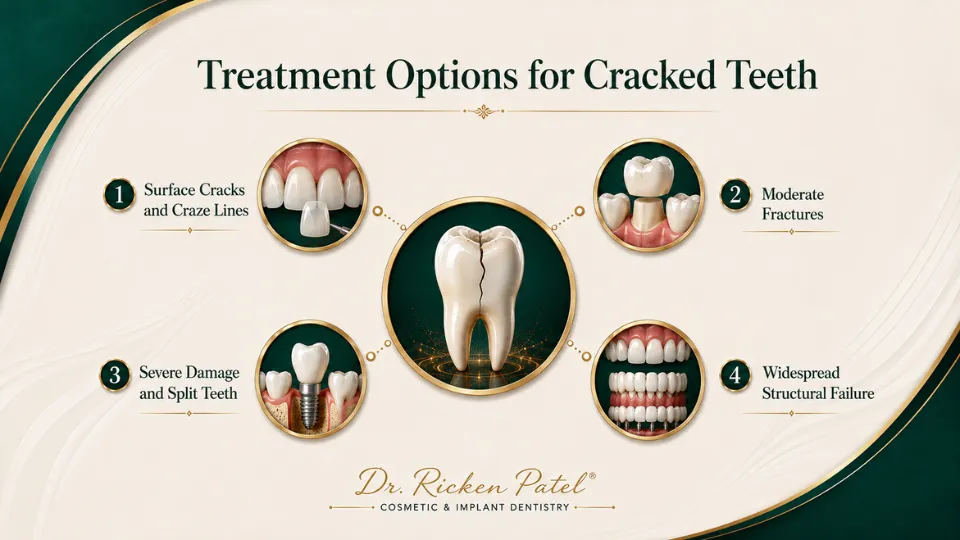
When a tooth fractures, the immediate goal is to relieve pain, prevent infection, and permanently restore function and aesthetics. Depending on the severity of the damage, a full spectrum of advanced cosmetic dental services is available to repair your smile.
1-Surface Cracks And Craze Lines:
If the tooth is structurally sound, Porcelain Veneers are bonded to the front surface to conceal cracks and restore its natural appearance.
2- Moderate Fractures
If a cusp has broken or a crack threatens the tooth’s integrity, custom ceramic crowns are used to bind the tooth back together, preventing the fracture from spreading.
3- Severe Damage And Split Teeth
When a tooth is completely split and unsalvageable, the required treatment is extraction followed by a single dental implant to replace the missing tooth and prevent structural shifting.
4- Widespread Structural Failure
When multiple teeth are severely cracked from grinding or erosion, treatment depends on the extent of the damage:
- Veneers: To restore aesthetics if the teeth are structurally stable.
- Full Mouth Reconstruction: To rebuild the bite using crowns for salvageable teeth.
- All-on-4 or All-on-6 Dental Implants: A permanently fixed, full-arch replacement for unsalvageable teeth.
When Should You See A Dentist?
If you suspect a fractured tooth, you must schedule an appointment immediately. Enamel does not regenerate, and daily chewing will inevitably widen a tiny fracture until the tooth splits or becomes infected.
As a Rutgers-trained dentist with 15 years of experience, Dr. Ricken Patel restores damaged teeth using a conservative, minimal-prep approach. By combining smile simulation with advanced bonding or custom crowns, he saves your natural teeth and ensures a strong, flawless smile.
Ready to Repair Your Cracked Tooth?
Don’t wait for the pain to get worse. Expert care is available to restore your smile.
Trusted by 15,000+ Satisfied Patients
Conclusion
Finally, understanding what makes teeth crack is the first critical step toward protecting your oral health and preventing premature tooth loss. Whether the damage stems from chronic nighttime grinding, acidic diets, or the natural wear and tear of aging, addressing the root cause and stabilizing the fracture immediately is essential. Ignoring a cracked tooth will only lead to escalating pain and complex complications. By taking proactive measures and seeking advanced restorative care, you can successfully repair the damage, eliminate discomfort, and secure a strong, beautiful smile for years to come.
FAQ about what makes teeth crack
1. Can a cracked tooth heal naturally?
No. Unlike living bone tissue, tooth enamel contains no living cells and cannot repair itself.
2. What makes your teeth crack suddenly?
Sudden fractures are typically triggered by biting down on hard objects like ice, popcorn kernels, or hard candies.
3. Is a cracked tooth considered a dental emergency?
Yes. If you experience severe pain when biting down or extreme sensitivity to temperatures, it indicates that the fracture has likely reached the inner nerve.